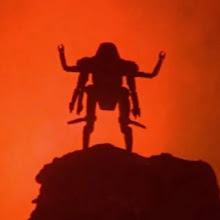
Five years ago today, on August 12, 2005, the documentary film Grizzly Man was released. Directed by noted documentarian Werner Herzog, the film is a captivating look at the bizarre life of Timothy Treadwell, who chose to leave civilization behind, live with bears in an Alaskan national park, and pay the ultimate price for that decision. Nearly three years ago, I did a piece on this film and the issues it raised (in which I included a brief interview with the coroner featured in the film). You can read that post here.
Showing posts with label Films of the 2000s. Show all posts
Showing posts with label Films of the 2000s. Show all posts
Thursday, August 12, 2010
Grizzly Man - Fifth Anniversary
Five years ago today, on August 12, 2005, the documentary film Grizzly Man was released. Directed by noted documentarian Werner Herzog, the film is a captivating look at the bizarre life of Timothy Treadwell, who chose to leave civilization behind, live with bears in an Alaskan national park, and pay the ultimate price for that decision. Nearly three years ago, I did a piece on this film and the issues it raised (in which I included a brief interview with the coroner featured in the film). You can read that post here.
Saturday, July 10, 2010
The Lovely Bones (2009)
 Peter Jackson should not make movies about murdered children. His The Lovely Bones, released last year and based upon the novel of the same name by Alice Sebold, attempts to create some type of macabre suburban fairy tale about the immediate afterlife of Susie Salmon (the talented child actress Saoirse Ronan), who died at the hands of the vile and villainous George Harvey (Stanley Tucci). Think of it as What Dreams May Come meets Little Children.
It's a little too creepy for a film about a child in the afterlife, and a bit too sentimental for a film regarding the hidden existence of a neighborhood child killer. Really, the film doesn't know exactly what it wants to be. Treatise on the hereafter? Murder mystery? Detective story? Coming of age story? Social commentary? Whatever the case, it didn't work.
This is perhaps strange, for Peter Jackson, back in the day, made a fine film about children who are also murderers. That film, of course, was 1994's Heavenly Creatures, starring Melanie Lynskey and Kate Winslet as two teens who plot to kill one of the pair's mother.
Tuesday, June 22, 2010
The Curious Paradox of Zooey Deschanel
 Not too long ago, I watched 500 (Days of Summer), the melancholy relationship movie featuring Joseph Gordon-Levitt and the lovely Zooey Deschanel as somewhat star crossed, ultimately doomed, lovers. As modern relationship flicks go, it's definitely worth seeing, as it nicely captures the electricity of initial romantic attraction and the bottomless pit of despair that accompanies the destruction of young love. Plus, there's plenty of references to The Smiths and The Pixies, so you're indie street cred will remain intact after viewing. In the film, Deschanel again showcases her lovely, mellifluous singing voice (which she uses in both Elf and Yes Man, if memory serves), but this movie prompts a discussion about the curious paradox she presents.
 That paradox being? Well, she typically plays a creative and offbeat character, one who is accepting of difference and mostly approachable. In real life, however, she is exceedingly hip.
Hipsters, of course, demand rigid adherence to their code of conduct.
They must disdain any who stray from that code.
So how hip is Zooey Deschanel?
1. She's named after Zooey, of "Franny and Zooey," the J.D. Salinger novella, suggesting that her hipster evolution began as early in life as possible.
2. She's married to Ben Gibbard, the lead singer of popular indie rock band, Death Cab for Cutie.
3. Her husband is not the only musician in the relationship. She is one half of She & Him, a band also featuring indie rock maestro M. Ward. (Note: Their two albums were released on Merge Records, home to many hip bands, including Arcade Fire and Neutral Milk Hotel.). Their haunting cover of The Smiths' "Please, Please, Please Let Me Get What I Want" appeared on the 500 (Days of Summer) soundtrack.
4. Obviously competing for Parker Posey's "Queen of the Indies" title, she has appeared in her fair share of good and bad low budget flicks. (My least favorite is the awful Flakes, a truly bad 2007 movie set in a world in which the free market supports not just one bar dedicated to the consumption of milk and cereal, but two.) I've often written that sometimes, an independent film is "independent" for a reason - it's bad and unworthy of studio financing. Whatever the case, Deschanel has dedicated herself to remaining true to her indie cinematic roots.

5. She's brunette, the preferred hair color of indie hipsters. True hipsters don't go blonde.
6. She's vegan (apparently by necessity, rather than by choice, due to allergies). Thus, it's not a flippant style choice or attempt at a political statement, it's actually medically appropriate.
7. She was cast to play Janis Joplin, although the film was never made, adding to her mythology.
 So, what to make of all of this? What does it all mean? If she is so insufferably and painfully hip, how is it that she can continue to play these accepting and approachable characters? As per the dictates of their compact, hipsters must cast disdain upon any and all things while simultaneously making (or wearing) ironic pop culture references. But in her performances, there is a sincerity, almost a vulnerability, which belies that stricture. Perhaps she's just a good actress and remains a doctrinaire hipster in real life. I'll never know. Alas.
Thursday, June 17, 2010
Bullet Dodged: P. Diddy did not play bluesman Robert Johnson (2003)
 According to reports in 2003, P. Diddy (a/k/a Puff Daddy a/k/a Sean "Puffy" Combs a/k/a Diddy) was to play the famed Mississippi Delta blues musician Robert Johnson in an upcoming HBO film, Love in Vain. This was of great concern. What to think then in 2003, and now, in 2010? (This was not quite as disturbing as the news that P. Diddy's ex-girlfriend, Jennifer Lopez, might remake Casablanca, but it is still rather difficult to imagine.) I assume that the film was based upon the unproduced screenplay of the same name which was published in book form a number of years ago. (If memory serves, Scorsese -- who wrote a foreword to the published screenplay -- was at one point attached to the project back in the 1990s.) Thankfully, seven years later, in June of 2010, we know that this casting decision was ultimately reversed. The film, actually, was never made, but surely now Diddy is too old to play the role. Thank the maker.
Sunday, June 6, 2010
Dead Snow (2009)
 Apparently, in Norway, vacationing medical students are as puerile as American high school students, or so we are led to believe by the first half of Dead Snow, a recent Norwegian horror flick. In the film, a group of young people trek to a remote cabin in the frozen mountains. What they don't know: the region is the home of a large group of zombified Nazi soldiers from the '40s. Written by Tommy Wirkola and Stig Frode Henriksen, and directed by Wirkola, the film is adequate zombie fare but seems internally inconsistent at the same time.
The first half of the film does not inspire much confidence in its quality. The young protagonists gab away like American teenagers, generally being obnoxious and certainly not acting like presumably more mature medical students. They engage in that staple of the postmodern horror movie: referencing popular culture and films with similar situations, mostly American horror films from the 1980s (including the mostly forgotten April Fool's Day). One character does, however, have the sense to wear a t-shirt emblazoned with the logo of a long ago Peter Jackson film. Watching the first half of the movie, though, it seemed indistinguishable from late 1980s horror film rubbish. How else to characterize the scene in which Chris (the generically hot Jenny Skavlan) and the rather goofy Erlend (Jeppe Laursen) have sex in an outhouse?
But then something happens.
As the film progresses, and the film abandons the carefree exploits of the medical students and evidence begins to suggest that strange things are afoot on this mountain, the tone of the film changes. It becomes much more interesting, and characters are forced to make desperate choices and live with their consequences. Suddenly, the film becomes more than just a recycled American teen slasher movie. One medical student, Martin (Vegar Hoel), initially suffering from an inexplicable fear of blood, must quickly overcome that phobia when bitten by a zombie. Another character, Hanna (Charlotte Frogner), chooses to force a deadly avalanche on the snowy mountainside rather than let a zombie take her. However, the boldness of the characters in the second half of the film doesn't match with the juvenile actions of the same characters at the film's beginning. Aside from the sudden appearance of a monstrous horde of zombies, there is no more meaningful explanation for the dramatic transition in character and in tone. Would that the characters had started out a bit more developed and seasoned in the first half of the film, the second half would feel a bit more earned.
Mythology wise, there's not much to the film. It's never really explained how the Nazi soldiers from the 1940s actually became zombies (or why, after six decades, their uniforms remain so well preserved). There's clearly some connection to a boxful of trinkets in the cabin, though it's unclear why the zombies are attempting to retrieve it. Whether that holds some key to their zombification, or whether it may allow them to again become human, is never quite explained.
But, if you're curious, be patient, and wait until the second half of the film before giving up on it.

Wednesday, May 19, 2010
Roger Dodger (2002)
 Most Hollywood films are lame, lame, and exhaustingly lame. The same cannot be said of 2002's Roger Dodger. Written and directed by Dylan Kidd, and starring Campbell Scott as the title character, the film also features the always lovely Jennifer Beals, Elizabeth Berkley, and Isabella Rossellini. In it, the always entertaining Scott portrays New Yorker Roger Swanson, a cynical cad, who dispenses practical (and sordid) relationship advice to his visiting sixteen-year-old nephew, Nick (Jesse Eisenberg, who you might recognize from last year's Zombieland). Think of Roger as the evil opposite of the character Scott portrayed in Cameron Crowe's Singles a decade before. Hardly the sort of tame wisdom of The Tao of Steve variety, Roger's shtick sends a single evening into a downward existential spiral from which there may be no escape.
 Swanson is no gentleman. The film opens with a scene showing him holding court at a restaurant, prognosticating the coming irrelevance of men in a not too distant future ruled by women. He always seems to know what to say and how to say it; he has an articulate retort to every remark. He's brash, he's confident, he's irreverent. In fact, the film's title comes from a childhood nickname bestowed upon Roger, who could talk his way out of any difficulty. Further, he prides himself on his ability to deconstruct women into a predictable stereotype. In one particularly illustrative scene, he encounters a young and nameless newcomer to the city, played by Morena Baccarin (depicted below), who Roger is able to categorize in just a few minutes. This verbal shakedown scores him little points with her, and he is left to drink alone at the bar. But in his unusual mind, he would rather be lonely and justified than kind and with company.
 It is for these reasons that Roger's nephew comes to visit him in New York. You see, Nick, is a sensitive soul, who, despite his sweet nature, comes to New York on a mission: garner some experience with the ladies, and best case, lose his virginity. Once he finds Roger, the two scour Manhattan for opportunities to accomplish that objective. As a part of this tutelage, Roger instructs Nick that "sex is everywhere," and in a curious sequence, the two men roam the streets of Manhattan, identifying different women of interest and ways in which to perpetrate the male gaze upon them. Later, at a bar, they encounter Sophie (Beals, depicted below) and Andrea (Berkeley), both of whom are intrigued by Nick's youth and his claim that he has bet Roger $1,000 that he cannot convince a woman to fall in love with him that very night. (That wager, of course, is a ruse perpetrated by Nick and Roger to intrigue the women, which works, because they spend a good portion of the evening speaking frankly about relationships and sex.). This exchange gives Nick a good deal of perspective on the female mind, and Sophie, more than two decades Nick's senior, offers him a tender kiss when Nick reveals he's not done that, either. But the novelty of the new friendship wears off for Sophie and Andrea when Roger increasingly interjects with crude remarks designed, ostensibly, to assist Nick's efforts.
 Roger is not as cool as he purports to be. After Joyce (Rossellini), his boss, terminates their secret romance, he spends the remainder of the film attempting to win her back in increasingly creepy ways. First, the day before Nick's arrival in the city, Roger attempts to gain access to Joyce's apartment late one drunken evening, but he is thwarted by her doorman. The following night, he, with Nick in tow, crashes a party at the apartment. When he is discovered, he causes a huge scene for all to see (save for Nick, who is facing his own moral dilemma in a bedroom with Donna (Mina Badie), a drunken co-worker of Roger's). By evening's end, Nick's mission is not yet a success, and the two must resort to the "fail safe," a underground brothel. A crisis of conscience ultimately prompts Roger to forcibly remove Nick from that den of iniquity.
In his review, Stephen Holden at The New York Times was almost smitten with Scott's character:
Usually, the dialogue in these sorts of indie flicks is overdone, but here, it's just right, especially as delivered by Scott. The following exchange between Nick and Roger takes place at Joyce's apartment party, just as the evening is beginning its inevitable decrescendo:One of the juiciest male characters to pop up in an independent film this year, Roger is the latest in a new breed of misogynous screen baddies introduced by Neil LaBute's films ''In the Company of Men'' and ''Your Friends and Neighbors.'' Although he can be charming, years of working his Machiavellian sexual ploys have rendered them rancid. Roger says he can read women's minds just by studying their faces. But when he psychs out possible conquests, his telepathic insights drip with hostility. When a woman in her 40's says she is waiting for her fiancé, he snidely warns her that her future husband will dump her after he wakes up one morning and realizes how old she is.
The role of Roger is a small coup for Mr. Scott, who is normally the quintessence of earnest sincerity on the screen. With a teaspoon of vinegar added, the same qualities this brilliant actor uses to project an empathetic sensitivity curdle into something smarmy and ferretlike, and his rich oratorical voice assumes the wheedling, coercive tone of a snake oil salesman. Watching his performance, I kept imagining what Kevin Spacey, who has played a number of Roger-like reptiles, would have done with the role. Because Mr. Scott is a more soulful actor, he makes Roger indelible by inflecting him with a hint of tragedy.
ROGER: There's an incredible moment that happens when a party passes its apex, its peak. As if by magic, suddenly every person in the room is acutely aware of the time. It is at that moment that the fear hits.By the film's final scene, we learn that Nick may well be the better for his impromptu trip to New York, although the experience certainly had its angry and emotional ups and downs.
NICK: What fear?
ROGER: The fear of the empty apartment.
NICK: Oh.
ROGER: Okay?
NICK: Yeah.
ROGER: That is more than most people can stand. Desperation creeps into the room like a fog. Eyes begin to search the crowd anxiously. Standards are drastically lowered. I mean, it's palpable.
Kidd's style of direction is very cinema verite; he opts for a documentary-style approach and an almost Dogme 95 style of lighting (which is to say that there is very little artificial light). This complements the film and gives it an immediacy that works with the narrative and the protagonists' end of the night deadline. One interesting component of the film is it's original music, particularly prominent during cab ride sequences, which you can sample in the YouTube video above. Below, you can find the official Roger Dodger film trailer.
Friday, May 14, 2010
Really? Another Robin Hood Film? Really?
 Today sees the release of yet another Robin Hood movie, this time a big budget Hollywood flick starring Russell Crowe and directed by Ridley Scott, both of whom worked together a decade ago on Gladiator. Crowe, of course, stars as Robin Hood, with Cate Blanchett as Maid Marian.
Here we go again.
Didn't we do this in 1991 with Kevin Costner, Morgan Freeman, and Alan Rickman? Is Robin Hood: Prince of Thieves so horrible or forgotten that we must revisit this well again?
But there's more.
 Hollywood actually produced not one but two Robin Hood films in 1991. There was the aforementioned version starring Costner, but another, Robin Hood, featuring Patrick Bergin in the title role and Uma Thurman as Maid Marian. (Bergin, you might remember, played the abusive husband of Julia Roberts' character in the 1991 film, Sleeping with the Enemy).
 In fact, the Robin Hood film club was so saturated that by 1993, Mel Brooks took on the genre with his Robin Hood: Men in Tights, with Cary Elwes as the famed bandit. (That film's best meta moment? The following line by Elwes: "[U]nlike some other Robin Hoods, I can speak with an English accent."). When Mel Brooks opts to parody something, just as when Weird Al decides to cover a particular song, the popular culture cycle is complete and should be shortly retired.
 But that's not all. Film history has some perfectly beloved classic films based upon the Robin Hood. Errol Flynn assumed the role way back in 1938 in The Adventures of Robin Hood. Great flick, although the costumes - especially that of Will Scarlett - do look a bit silly 72 years later. The best exchange in that film? Lady Marian: Why, you speak treason! Robin Hood: Fluently.
 There's even the 1973 Disney animated film, Robin Hood, which I must confess, seemed to me to be a lot older than 1973. Whatever the case, cinema culture is inundated with Robin Hood adaptations. There's even a BBC series based on the Robin Hood legend which began to air three years ago. There can be no justification for further meddling with this medieval tale. Alas.
Thursday, May 6, 2010
Bullet Dodged: Jennifer Lopez and Ben Afflect Do Not Remake Casablanca (2003)
 Perhaps it was all just a publicity stunt or a bad rumor gone awry. We'll never know. But whatever it was, the stakes were simply too high to ignore it. In 2003, history spared cinemagoers from a possible remake of 1942's classic film, Casablanca, starring Ben Affleck and Jennifer Lopez. Lopez as Ilsa from the block? (Check out this tongue in cheek piece from Entertainment Weekly on the possible remake which was run about seven years ago.). Looking back, I wonder if it was all a ruse, as the news did break in April of 2003, and April, as well all know, is the month of fools. But the joke did not end on April 1, 2003 and lingered for several weeks. Whether Affleck and Lopez - who would split sometime thereafter - actually had the gall to attempt such a remake was never confirmed. But looking back, and seeing how we in 2010 view lackluster actor Affleck and pop culture joke Lopez, it would be curious to see what such an effort produced. Instead, the couple perpetrated the film, Gigli, which was released in August 2003 to nearly universal ridicule, and Jersey Girl, which suffered a similar fate in 2004.
 [Somewhat Related Trivia: Did you know there was a 1983 Casablanca television series in the early 1980s which featured Ray Liotta and Hector Elizondo? Why isn't that on DVD?]
Wednesday, May 5, 2010
Gladiator (May 5, 2000)
 Ten years ago today, on May 5, 2000, the big budget blockbuster Gladiator hit theatres. Directed by Ridley Scott, and starring Russell Crowe, the film was a huge success. It made Crowe an action hero, gave a star turn to Joaquin Phoenix, and became the last film of Oliver Reed. (It also featured the lovely Connie Nielsen.). But what to say about it ten years later?
It certainly had its moments. But the film, occasionally fun, but mostly mediocre, could have showcased a bit more Roman architecture via CGI, and its supernatural elements could have been omitted to make the Maximus narrative more compelling. Certainly, it was undeserving of the Best Picture accolade, but it received it anyway, likely due to its financial success more than anything else. But here's the real question about its legacy: How many DVD players were sold in 2000 as a result of this film? Remember, back then, the DVD player was a new technology, and consumers always need that extra push over the cliff when adapting to new audiovisual components. But could they justify the acquisition of a new system when it would enhance the experience of watching a big budget flick like Gladiator? Very likely. I suspect that for many mainstream consumers, this film was that last push (just as the newly released Avatar may be for Blu-Ray players today). So for that, we must say thank you, Gladiator. You helped us to adopt a new video technology that would become obsolete just a decade later. Thanks.
Monday, May 3, 2010
Five Questions After Watching Zombieland
 This past weekend, I watched Zombieland. Written by Paul Wernick and Rhett Reese and directed by Ruben Fleischer, the film stars Woody Harrelson, Jesse Eisenberg, Emma Stone, and Abigail Breslin, all as survivors of a plague that has turned the world into a horde of zombies. It's a fun flick, though at times, it seemed it didn't know what it wanted to be. Rom zom com, a la Shawn of the Dead? Modern zombie action flick, a la the 2004 remake of Dawn of the Dead? Or the hipster flick, Adventureland (also featuring Eisenberg), but with zombies? I enjoyed the film, as I do most zombie movies, but it prompted the following five questions which deserve answers.
1. Jesse Eisenberg finds himself in the Michael Cera role in his films: the geeky, socially awkward young man who fumbles about with women. Do you think that Eisenberg, when he realized that he was up for a part in zombie flick, thought to himself, "Gee whiz, finally a film in which I won't play a geeky adolescent?" Guess again: Eisenberg plays Columbus, whose social awkwardness is prominent in the film and in fact serves as a key plot component. (To boot, his introverted nature prompts his personalized set of survival rules in the zombie-infested world.). He develops a crush on Wichita, played by Stone, with whom Eisenberg has zero chemistry.
2. Prior to the zombie apocalypse, Columbus attends college in Austin, Texas, where he spends most of his time hidden away from the world in his apartment on his computer. He first learns of the zombie menace from "406," his generically hot blonde neighbor (Amber Heard), who he inexplicably refers to by her apartment number. Apparently, Columbus and 406 have developed a platonic friendship in which he consoles her after she experiences some type of emotional hardship. He fancies her, but she uses him solely as a prop. In a flashback, we see the two of them on his couch, he pining away for her, she relating a story about an unusual homeless man who bit her. They fall asleep on the couch, but when he awakes, she is a full fledged zombie, who proceeds to chase him around his very, very large apartment. Knowing a bit about the sizes of apartments in Austin, Texas, I can say that no college student could effectively elude a zombie for as long as Columbus did in an average sized apartment. The problem: His apartment is far, far too large for any college student, much less one in the Texas capital city. What gives?
3. Further, how does a film in which the protagonist is a college student in Austin not take place in Austin, or even have a single scene set in that city? The film opens in Garland, Texas, which the narrator sees fit to dismiss as post-apocalyptic in nature even before the zombie apocalypse.
4. Much ado is made of the characters' attempt to make it to Pacific Playland, an amusement park in Los Angeles. When they arrive in the City of Angels, though, there are very, very few zombies. They see a handful on the streets of downtown L.A., which seems puzzling, due to the city's size and population. Later, when Wichita and her young sister, Little Rock (Little Miss Sunshine's Abigail Breslin) arrive at the park and activate the carnival lights (which serve to attract the walking dead to that location), less than a 100 zombies appear. Los Angeles is the second most populous city in the United States. Where are all the zombies?
 5. Skilled zombie killer Tallahassee (Harrelson) craves but one thing in the film: a Twinkie. He spends much time looking in abandoned grocery stores for this snack cake, suddenly elusive in the new zombie world. Can you imagine the product placement meeting between the producers and Hostess? "Uh, yeah, our psycho zombie killer character, played by Woody Harrelson, really wants a Twinkie to help him cope with all this killing of the undead. Can we use your logo and reference your products?" Um, okay.
Wednesday, April 21, 2010
Happy Administrative Professional's Day
 Happy Administrative Professional's Day!
To celebrate this day, I offer the following thoughts on the 2002 film, Secretary, written by Erin Cressida Wilson, Mary Gaitskill, and Steven Shainberg, directed by Shainberg, and starring James Spader and, of course, the lovely Maggie Gyllenhaal as the title character:
- Gyllenhaal really came into her own with the role of Lee Holloway, and I'm not sure that any other actress could have played it with the same type of sweet vulnerability. Prior to that, she was playing the best friend character to other female leads. With this film, she illustrated that she could play the lead herself, and has done so now, for some time.
- Spader has had an interesting career arc, hasn't he? He began by playing smug villains in 1980s movies like Pretty in Pink and Less Than Zero, and later, evolved into a nerd hero in movies like Stargate. Ultimately, though, he revealed that he was born to play creepy lawyers, as he did in this film as attorney E. Edward Grey, and later in "The Practice," the TV series which gave birth to his character, Alan Shore (a role which would unfortunately be watered down considerably when spun off into a new series, "Boston Legal").
- During a wedding scene early in the film, Lee dances with her father, Burt (Stephen McHattie), to Frank Zappa's "Directly from My Heart to You," from his 1970 album, Weasels Ripped My Flesh. You can't go wrong with that.
- Early in the film, when Edward and Lee realize that they share mutual interests and affection for each other, a montage of their newly refined working relationship is set to Leonard Cohen's "I'm Your Man" (from his 1988 album of the same name).
- Anachronisms abound. Grey's law office contains no computers, and Lee uses an old school typewriter to do Grey's dictation. Even the phones are ancients. In fact, there's something very retro and bizarre about Grey's entire law office set up, but it works.
- In sum, the chemistry of the two offbeat and off kilter main characters, coupled with the aforementioned odd set dressing for Grey's law office, is reminiscent of the work of David Lynch. If you've not seen the film, or if it's been a while since you've seen it, celebrate Administrative Professional's Day by revisiting the film for good measure.
Friday, April 2, 2010
High Fidelity: Jack Black Covers Marvin Gaye
 What to say about Jack Black, the over the top comedian who rose to prominence with his role as Barry, the obnoxious record store clerk, in the 2000 film, High Fidelity? As the final installment of this site's coverage of the tenth anniversary of the release of that film, we pause to reflect upon Black's performance at the end of the film, during which he covers Marvin Gaye's immortal classic, "Let's Get It On." His emotive version of this tune is important, as the viewer is left with the impression throughout the film that Barry is nothing but a pretentious hack lacking any talent whatsoever. He brags about his musical efforts, but none of his friends or co-workers really believe that he has any musical chops whatsoever. Throughout much of the film, he banters about his band, Sonic Death Monkey, which is renamed several more times during the movie, once to Kathleen Turner Overdrive and again to Barry Jive and the Uptown Five. Thus, when he rises to take the stage at the film's end, everyone, the viewers of the film, assume that he will crash and burn. But he does not. He delivers a fine rendition of the song. And the film ends.
In 2000, I didn't know much about Jack Black, and I suppose not many others did, either. Of course, I had seen some of the films in which he appeared before High Fidelity, but I doubt I knew who he was at the time. (I adore the 1992 film Bob Roberts, in which Black appears as a sycophant of the rebel conservative title character.). He had already appeared in the Tenacious D television series, but I wasn't really familiar with it. But it was High Fidelity in which he truly came to light as a comic actor (although he has certainly appeared in his fair share of stinkers since then, including the wretched Shallow Hal and the even worse King Kong remake). But for every few instances of cinematic detritus, he charms us in a film like School of Rock. What to do?
 And so it was with his first major role in High Fidelity, featuring his fateful homage to Marvin Gaye. How did that come to pass? In fact, it was Black himself who chose the song he would cover in the film, as one news account from April 2000 notes:
Tenacious D fans will be shocked to hear lead singer Jack Black sing "Let's Get It On" at the end of "High Fidelity," but it was Black himself who chose the song. Black is known more for his heavy-metal parodies than the sweet rendition of the Gaye standard that closes the movie starring John Cusack. "I pushed for the song that they ended up using just 'cause I thought I could sing it well. They were talking about me doing another Marvin Gaye song that I didn't think rocked as hard. I wanted to really get a good clop in the chops at the end of the movie." Black plays a bombastic music snob who works in a record store.1Curiously, though, the soundtrack to the film featured not the live version depicted on screen but a far more restrained studio version. I recall reading an article at the time, or shortly thereafter, indicating that Black had hoped one of the live versions recorded on film would appear on the soundtrack, but that when the soundtrack was released, the studio (or the record company) had included the studio version, which can only be characterized as lifeless. Alas.
Since 2000, Black has become a major star. Whether this is a good thing, the jury is still out. Well, it's probably a good thing, as he does make us laugh, every so often.
This brief article, of course, would not be complete without a link to the video:
1. "People," Cleveland Plain Dealer (April 20, 2000).
Thursday, April 1, 2010
High Fidelity: Stiff Little Fingers' "Inflammable Material"
 As a part of today's installment of this site's coverage of the tenth anniversary of the release of the 2000 film High Fidelity, we pause to reflect upon that movie's homage to the 1979 debut album of the Northern Ireland punk band, Stiff Little Fingers. And in so doing, we feature an original interview with Damian Rogers, an actress featured in that scene. In the film, record store clerk Dick (Todd Louiso) uses his knowledge of Green Day's influences to flirt with a customer, Anaugh (Sara Gilbert). Dick informs her that in addition to The Clash, one of Green Day's biggest influences is Stiff Little Fingers, whose album, Inflammable Material, he produces and begins to play over the store's system. As he does so, one customer (Rogers) asks if he's playing the new Green Day album. This amuses Dick and Anaugh.
Stiff Little Fingers is a band I probably never would have discovered had I not gone through a punk phase in the last decade. Sure, I remembered the scene from the film, but it was not until several years later that I stumbled across and purchased Inflammable Material. I can recall lounging about in a chair as the record playing and then sitting straight up as "Suspect Device," the album's first track, came over the speakers and shook me from the adjacent room. (Another stellar song on that album is "Alternative Ulster."). The band certainly has an energy that few groups - even those labeled punk today - apparently lack. When "Suspect Device" crashes into its chorus, there is no better example of punk rock. If you've not heard their debut album, or any of the live recordings from the 1970s, investigate them. As the years passed, the band altered its musical approach a bit, and by 1982, the band had a slightly poppier feel, as can be evidenced by its album, Now Then . . . The band has broken up, reformed, and to this day, still tours.
Here's the dialog from the scene in question:
DICK
Well, the interesting thing about Green Day is that, um, so much of their music is, in truth, directly influenced by, in my opinion, uh, two bands.
ANAUGH AND DICK
The Clash.
DICK
Uh, correct, The Clash. Uh, but also by this band called the Stiff Little Fingers. Um, I think you would really love this band.
 At this point in the film, Dick begins to play "Suspect Device" over the record store's speakers. It's actually difficult to hear and distinguish in the scene. (A neat aside: This scene has been referenced by the band on its Twitter account.). The scene continues:
Well, the interesting thing about Green Day is that, um, so much of their music is, in truth, directly influenced by, in my opinion, uh, two bands.
ANAUGH AND DICK
The Clash.
DICK
Uh, correct, The Clash. Uh, but also by this band called the Stiff Little Fingers. Um, I think you would really love this band.
 At this point in the film, Dick begins to play "Suspect Device" over the record store's speakers. It's actually difficult to hear and distinguish in the scene. (A neat aside: This scene has been referenced by the band on its Twitter account.). The scene continues:
ANAUGH
It sounds great. My name's Anaugh.
DICK
The name's um . . . My name's Dick.
 GREEN DAY GIRL
Is this the new Green Day?
In response, Anna and Dick share a knowing glance (despite the fact that Anaugh didn't know of the existence of Stiff Little Fingers until just a few moments before).It sounds great. My name's Anaugh.
DICK
The name's um . . . My name's Dick.
 GREEN DAY GIRL
Is this the new Green Day?
 "Green Day Girl" was played by Damian Rogers, originally from Detroit, but in 1999, a Chicago resident. She can be seen in the image above in between Anaugh and Dick, at the very moment in the film where she asks her question about Green Day. (She can also be seen in this image, which was used in my previous post about the Beta Band, as well as in the background of a few other images in this post.). Last week, Rogers was kind enough to submit to an email interview with this site, in which she discussed her involvement with the film and professed a wistful nostalgia for the Chicago she knew in the late 1990s. (We here at this site fully support any type of nostalgia for the 1990s and appreciated her thoughts and memories of the era.).
Without further ado, the interview with Ms. Rogers is as follows:
1. How did you become a part of the film, High Fidelity?
A lot of the extras in High Fidelity — and in that scene especially — were people who actually spent a lot of their time and money at independent record stores in Chicago, like Reckless Records. I had become friends with a couple people who were working on the film and lots of people I knew were participating in one way or another.2. You are credited as "Green Day Girl." What do you remember about the filming of your particular scene?
It was a total fluke I ended up with a line. That line was supposed to be delivered by Al Johnson from the band U.S. Maple, but then he was cast in a larger cameo in a different scene. ([Jack Black's] character tortures him by refusing to sell him some rare vinyl — I’m pretty sure it’s a Captain Beefheart record.). So the line was up for grabs on set and they gave it to me minutes before shooting that part of the scene.
Most of the people playing customers sifting through records in the background were a part of the Chicago music scene at the time, or at least, a particular corner of it. Ian Williams (formerly of Don Caballero and Storm & Stress, currently of Battles) has some prominent face time. A bunch of my old friends and acquaintances are in it, so when I watch it, I am totally distracted by my instinct to scan the screen for their split-second appearances.
As for the day of filming, I remember milling around, lots of waiting, sitting with my friend Nicole as she grew increasingly bored and irritable. I remember that one of the professional extras made a point of asking me why so many of us already knew each other.
It was an interesting way to spend a day of my life. A long, repetitive day, mostly spent watching other people work, but interesting nonetheless. And due to union contracts, I was issued an empty trailer when I was upgraded from non-speaking shopper to “Green Day Girl.” This delighted me, even though I didn’t have the opportunity to lock myself in there.

3. Were you previously familiar with the band, Stiff Little Fingers, whose song plays and is referenced in that scene?
I’d heard their name, but I don’t think I’d ever listened to them at that point. (Though my husband owns a couple of their records, so they’re in the house now.) As far as the movie’s soundtrack goes, I’m more into the old psychedelic stuff and the Drag City artists — Love, 13th Floor Elevators, Kinks, Smog, Plush, Royal Trux, etc.4. Did you talk music with any members of the principal cast? If so, what did you discuss?
I have no memory of talking about music with any of the members of the principal cast. I did have a number of conversations about music with people working on the production side. The screenwriter and music supervisor was already deeply engaged in Chicago’s underground and independent music scene — his name still pops up in the liner notes of various Drag City releases. I can’t really watch the movie objectively, but I would credit any sense of authenticity to a real effort on the part of the filmmakers to involve people they respected in as many aspects of the film as possible.Rogers is not the only one online with a nostalgia for the Lounge Ax. A Facebook group called "I Miss The Lounge Ax" boasts 903 members as of this writing. (Additional information about the now defunct club can be found here and here.). Here's the scene featuring Bonet performing at the Lounge Ax referenced by Rogers in her interview:
The last time I saw High Fidelity — I’ve actually only seen it twice in its entirety — it made me a bit nostalgic for a time and a place that is ten years (and a couple cities now) behind me. The scene in which Lisa Bonet is singing as “Marie De Salle” was shot at the rock club Lounge Ax, a place I spent many, many nights. In 1999, it seemed to be the center of my social and emotional world in a way I doubt another public establishment ever could be again. Maybe it was only really for a few years, but I felt like I lived there, with all that that implies.
Lounge Ax closed at the beginning of 2000, the year the film was released, also the year I left Chicago for New York. It’s a place that survives in images and memory, but that I can’t go back and visit. It’s bittersweet to see it onscreen. For me the whole movie is a surreal blend of artifice and document. I appreciate it as a kind of collision worlds. I remember a friend of mine’s boyfriend was bored by how breathless and star-struck all these supposedly jaded hipsters became when Hollywood came to town for a few months. “It’s not the fucking Taj Mahal,” he said. “It’s a movie. In a couple years, the video will be on sale in the used bin at Reckless.” (I did, in fact, buy the DVD from a used bookstore around the corner from me in Toronto.)
But it seemed very important and exciting at the time. I suppose, like everything, it’s relative. I remember when I was spending every night at Lounge Ax filming bands during the last two weeks they were open, one of my colleagues at the literary journal where I worked marveled at my commitment, confused by my grief. After all, he pointed out, “It’s only a bar.”
Rogers's official site can be found here (and, if you're on Twitter, you can follow her here). She describes herself as "an American-born poet who now lives in Canada" who "sometimes writes about music." Her first book of poems, Paper Radio, was published in the fall of 2009. (You can hear her read some of her poems at her MySpace page.). Its cover is below:
 Finally, the scene in question featuring Louiso, Gilbert, Rogers, and the music of Stiff Little Fingers can be viewed here:
Wednesday, March 31, 2010
High Fidelity: The Minutemen's "Double Nickels on the Dime"
 As a part of today's installment of this site's coverage of the tenth anniversary of the release of the 2000 film High Fidelity, we pause to reflect upon that movie's brief homage to an old Minutemen album. And in so doing, we feature an original interview with Chris Rehmann, one of the actors from the scene in question (featured in the image below wearing the Charlie Brown t-shirt). But, first, onto the music: Featured briefly in the film is the 1984 Minutemen album, Double Nickels on the Dime. Two hooligans, Vince (Rehmann) and Justin (Ben Carr), shoplift a handful of LPs from Championship Vinyl, located in Chicago at the corner of Milwaukee and Honore streets and owned by protagonist Rob Gordon (John Cusack). Gordon spots the two shoplifters just as they are about to leave the store; he yells to his employee, Barry (Jack Black), to bar the door, but Barry is too late, and the thieves flee the premises. Rob and Barry immediately give chase outside the store and around the corner.
 Gordon and Barry catch up to them, and Gordon orders them to halt, which they do, when the two young punks realize that Gordon has their skateboard, which may be more valuable than the pilfered records. The two miscreants them toss their records and tapes onto the sidewalk:
 Gordon seems surprised at the records that they have stolen, going so far as to ask if they are taking them for someone else. (Note in the image above the copy of the Minutemen album at issue as well as the copy of 1978's Music for Films by Brian Eno. Gordon also professes surprise at their pilfering of music by Ryuichi Sakamoto, Serge Gainsbourg, and Sigue Sigue Sputnik.). The two young thieves scoff at Gordon's disdain, suggesting that Gordon is a musical bigot to think that just by looking at them he can discern what music they should or do in fact enjoy.
The encounter ends with the two sets of adversaries parting ways (although Gordon later learns that the two thieves are musicians in their own right, and he elects to produce their first EP).
 For me, the Minutemen was one of those bands that I had always heard of, but never truly discovered until later adulthood, when I could afford to experiment and buy expensive selections from the SST Records back catalog. (Try finding a new copy of one of their LPs for under $16!). Around 1991, I bought a copy of the SST Records compilation, SST Acoustic, which featured one track by the Minutemen, "Stories," which originally appeared on the band's final album, 1985's 3-Way Tie (For Last). That album, of course, was released very shortly before the untimely death of D. Boon, who along with Mike Watt, was the core of the band. It was not until a number of years after I bought the acoustic compilation that I discovered Double Nickels on the Dime, which is really an epic example of the fusion of punk and other genres from the mid-1980s.
Last week, Rehmann kindly agreed to an interview, in which he reflects upon the filming of the scene in question and his memories of shooting in Chicago ten years ago. He recalls:
I got the part when the director Stephen Frears and a casting agent Claire Simon came to a Second City class I was in. They asked me to come and audition for the part. A friend from the second City Alum named Tim O'Malley coached me through the audition and helped me get the part.Since High Fidelity, Rehmann has appeared in What about Joan (a television series starring John Cusack's sister, Joan), Early Edition, and a few television commercials but, as he notes, "nothing as big or cool as being part of High Fidelity."
I was new to how film worked as it was my first paying job. I was just thrilled the entire shoot. I remember that my first day on the set was to do my hair. The spots. Due to the director and producers having to check out how dark or light the spots or blond was it took seven hours before I was done.
Shooting the part when we got busted was interesting because the set was in a studio and the outside was set on location. So it was run out the door. Then two weeks later we were running away from the door. Jack Black was also a lot of fun in between takes, joking around a lot.
I was not [previously] familiar with the Minutemen. I did not get a chance to talk much music with the cast. Everyone was so busy, except Jack Black, who took the time to hang out, that I did not have much time to talk music. I did overhear discussions by the producers on what music they wanted in the film and one time let John [Cusack] listen to it when he was in make up. I was not in make up with him much and he ate his lunch mostly in his trailer.
The fondest memory was getting the part meeting John Cusack and Jack Black, and then shooting in the double door for the club scene near the end of the film. I was able to watch Jack sing, and it was just a lot of fun. I also got to improvise the part where I was stealing again and when seeing the movie with friends, it got a laugh. So I was proud of that.
Here's another scene featuring Rehmann, Carr, and Cusack:
Anthony Ortale, a Flickr user, has posted a photograph of the exterior that was used for Championship Vinyl in Chicago and the scene at issue in this post. As Rehmann noted, the film's scenes inside the record store were on a set, but the exterior was on a street corner in Chicago. See Ortale's photograph, which shows the site now all boarded up, here.
Tuesday, March 30, 2010
High Fidelity: The Beta Band's "The Three E.P.'s"
 Today, as a part of this week's coverage of the tenth anniversary of the release of High Fidelity, we turn to The Beta Band. There's a scene in the film, in which Rob Gordon (John Cusack), pauses to survey the scene in the record he owns, Championship Vinyl. He notices customers walking through the establishment and browsing, but he decides to take matters into his own hands. He retrieves a copy of The Three E.P.'s, a 1998 compilation of, well, three previously released extended plays by The Beta Band, the British band that some have dubbed "folktronica." Perhaps that's just one way of saying that their music is catchy?
 Gordon turns to his employee, Dick (Todd Louiso) and whispers "I will now sell five copies of The Three E.P.'s by The Beta Band." "Do it," replies Dick, with gravitas. He does, and the album's first track, "Dry the Rain," begins to play over the store's system. As it does so, Rob surveys the store, waiting for (and clearly expecting) a reaction from his clientele. He waits.
(It should be noted that when the song begins, its opening sequence is truncated. The portion of that is first heard is actually several moments into the song, rather than its initial beginning.).
 Sure enough, the customers react.
One man, who is grooving to the music, asks Rob, "Who is that?"
"The Beta Band," Rob replies.
"It's good," says the customer.
"I know," says Rob, very sure of himself.
 I remember seeing this scene in 2000 and being driven to investigate The Beta Band, a group about which I knew little, if anything, at the time. Sometime thereafter, I found myself at San Antonio's Hogwild Records, where I picked up a copy of The Three E.P.'s, which I remember wearing out at that time. A fine album, actually, and "Dry the Rain" does indeed provoke the same sort of reaction depicted in the film when first heard by an unsuspecting listener. Several years later, when I began frequently downloading music from the iTunes Store, I would also acquire the band's 1999 self titled album and their 2001 record, Hot Shots II (which Wikipedia alerts me know to confuse with the 1993 film, Hot Shots! Part Deux). Apparently now defunct, the band would release one more record in 2004 before calling it quits.
It's actually unusual in a film for a character to pick up a copy of a compact disc, mention both its title and artist, and the play a song from the referenced album. Here, Gordon does just that, which allows the viewer to later track down the song far more easily. (Remember, this was in the days before Shazam.). "Dry the Rain" would also appear on the film's soundtrack.
Below, you'll find a clip from High Fidelity, which includes the above referenced scene (as well as a scene featuring a discussion of Stiff Little Fingers to be discussed later this week).
Monday, March 29, 2010
High Fidelity (2000) - Tenth Anniversary
 Ten years ago this week, on March 31, 2000, the wonderful film High Fidelity starring John Cusack and directed by Stephen Frears, was released in theatres across the nation. Anyone who has survived - or attempted to survive - a crumbling relationship can relate to this film, which relies heavily on its source material. Indeed, those familiar with the original 1995 book by Nick Hornby know that the adaptation was nearly flawless, with just a few changes to transplant the narrative from the U.K. to Chicago, Illinois. Cusack, essentially playing John Cusack, tortures himself by recounting the most excruciating break-ups of his life. In his confessions, he provides some surprising insight and a number of touching sentiments. Also interesting are Cusack/Hornby's observations as professional appreciaters - unpaid critics who cast their disdain upon those can't see what they see in music (as well as how music itself often fosters the misery of the broken-hearted). Jack Black - still early in his career - showcases his comic talents as Barry, the obnoxious record store clerk and frontman of the mighty band, Sonic Death Monkey. Popular music is almost a character in and of itself, as the characters are constantly referencing this album or that, and relating how particular songs and records affect their lives.
 I have seen this movie many, many times. Many times. Surely you've seen it, too, and know the characters and plot all too well. This week, I plan to do a brief series of posts regarding some of the albums and music mentioned in the film, including some that are pivotal in particular scenes in the film. So, without further ado, this week, you can expect posts on the following:
- Monday, March 29, 2010: High Fidelity - Tenth Anniversary Intro
- Tuesday, March 30, 2010: The Beta Band - The Three E.P.'s
- Wednesday, March 31, 2010: The Minutemen - Double Nickels on the Dime
- Thursday, April 1, 2010: Stiff Little Fingers - Inflammable Material
- Friday, April 2, 2010: Jack Black Covers Marvin Gaye

Subscribe to:
Posts (Atom)