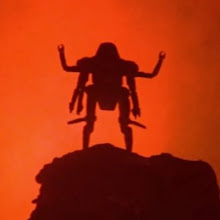
Seven years ago this week, in June of 2003, the Houston-based electronica outfit, The Entertainment System, released the long-awaited Decibel Hunter, its second full length album. It is surprisingly catchy and accessible for the sort of experimental synth the group played.
According to reports in 2003, P. Diddy (a/k/a Puff Daddy a/k/a Sean "Puffy" Combs a/k/a Diddy) was to play the famed Mississippi Delta blues musician Robert Johnson in an upcoming HBO film, Love in Vain. This was of great concern. What to think then in 2003, and now, in 2010? (This was not quite as disturbing as the news that P. Diddy's ex-girlfriend, Jennifer Lopez, might remake Casablanca, but it is still rather difficult to imagine.) I assume that the film was based upon the unproduced screenplay of the same name which was published in book form a number of years ago. (If memory serves, Scorsese -- who wrote a foreword to the published screenplay -- was at one point attached to the project back in the 1990s.) Thankfully, seven years later, in June of 2010, we know that this casting decision was ultimately reversed. The film, actually, was never made, but surely now Diddy is too old to play the role. Thank the maker.
Perhaps it was all just a publicity stunt or a bad rumor gone awry. We'll never know. But whatever it was, the stakes were simply too high to ignore it. In 2003, history spared cinemagoers from a possible remake of 1942's classic film, Casablanca, starring Ben Affleck and Jennifer Lopez. Lopez as Ilsa from the block? (Check out this tongue in cheek piece from Entertainment Weekly on the possible remake which was run about seven years ago.). Looking back, I wonder if it was all a ruse, as the news did break in April of 2003, and April, as well all know, is the month of fools. But the joke did not end on April 1, 2003 and lingered for several weeks. Whether Affleck and Lopez - who would split sometime thereafter - actually had the gall to attempt such a remake was never confirmed. But looking back, and seeing how we in 2010 view lackluster actor Affleck and pop culture joke Lopez, it would be curious to see what such an effort produced. Instead, the couple perpetrated the film, Gigli, which was released in August 2003 to nearly universal ridicule, and Jersey Girl, which suffered a similar fate in 2004.
[Somewhat Related Trivia: Did you know there was a 1983 Casablancatelevision series in the early 1980s which featured Ray Liotta and Hector Elizondo? Why isn't that on DVD?]
Seven years ago today, on February 17, 2003, the finale of the television reality show "Joe Millionaire" aired. A quick refresher: This was one of the first reality in shows in which the contestants were tricked into believing a critical fact was simply not true. In fact, the contestants, all female, were led to believe that Evan Marriott was a millionaire when in reality he was just short of being a pauper. Even to this day, reality television remains the trendy schadenfreude , and even those of us at Chronological Snobbery are not immune from the strange transfixing power it holds over the nation. After weeks of a cynical ploy implemented for the entertainment of millions, the finale is a sugar-coated and sappy fairy tale cliche? Since when did the Fox Network, perpetrator of "Married . . . with Children" and "When Animals Attack!", become the plaything of rank sentimentalists? Evan receives no comeuppance for his dastardly scheme to dupe women into believing that he was as rich as Mr. Burns? Yes, of course, I was just as amused by the program as everyone else seems to have been, but I was hoping that perhaps Evan would-be the victim of some additional ploy known only to the network suits. It was not to be. The concept was a bit of a one trick pony; one the ruse was perpetrated, it could not be employed again, as the secret was out. The producers were undeterred; they tried again, this time using European women (under the assumption that they were unfamiliar with American reality television). But the magic, if it can be called that, was gone.
On February 14, 2003, seven years ago today, the then Houston-based electronica outfit, The Entertainment System, released a single, "Celebrate Black Wednesday." The original email press release for the release of this single, captured for the sake of posterity, is as follows:
SPECIAL VALENTINE'S DAY RELEASE! Yes, The Entertainment System, in light of having taken a year or two too long to finish our album, has just released a special Valentine's Day single featuring the song "Celebrate Black Wednesday" off the forthcoming (hopefully in a month) Decibel Hunter album. Also included are the bonus tracks "The Film Song" and "Ripper." The single is available locally at Sound Exchange and Cactus Music and Video, and of course, via parcel post, through [band member Maurice Carter].
The band, long dormant due to members moving to different parts of the country, is preserved on the Internet like a fly in the amber. Comprised of vocalist/programmer Kim, vocalist/guitarist Dorvin Rosenthal, and synthesizer player/sound designer Maurice Carter, the band now belongs to the ages. It long ago went dormant, never again to rise into the Houston music scene. The album referred to in the email press release was Decibel Hunter, the group's last effort . Those curious to hear the single can access it here, at the band's MySpace page. (Direct hyperlinks are necessary with this group, of course, because their moniker is not exactly Google-friendly. Try to find them on the Google. I dare you.).
Recently, Maurice Carter, the band's keyboardist, submitted to an email interview.
1. Take us back to 2003. How did you decide to write "Celebrate Black Wednesday"?
Well, I'm certain the song's older than that. Valentine's Day fell on a Wednesday in 2001 and I'm pretty certain the song dates to events or references from that particular Valentine's Day.
That was one of the songs Dorvin had initially demo'd on his four-track that we re-recorded for Decibel Hunter (other example's include "Cigarectomy" and "Columbus on the Rocks"). Unrequited and/or abusive love are frequent themes in Dorvin's lyrics, so I have no idea if this song is about a particular incident or just general imagery. Although we re-recorded it, the arrangement closely follows the original as far as I recall, so Dorvin deserves arranging as well as writing credit (and, of course, he played most of the instruments). Even though the last half of the song is essentially just the same melody repeated over and over, he had very explicit ideas about how the sound and aesthetic should slowly change with each additional instrument and sound. A particularly fulfilling song to play live.
2. How did it come to be released on Valentine's Day 2003 (which, actually, was not a Wednesday)?
Well, all three of us write rather obscure lyrics, so we're frequently unsure of the exact motivation behind the other's writing. In the case of "Celebrate Black Wednesday," though, we at least knew it was about painful love and Valentine's Day, a theme close to all our hearts at that point, if I recall.
Ultimately, though, it was just a case of needing a deadline. We'd been working on Decibel Hunter for a good 4+ years and the perfectionism was killing us. We were proud of what we'd been producing but unable to bring it to that final point that we could actually put it before the public. The idea of doing a single off Decibel Hunter reduced the pressure. A particular problem here was Kim, whose perfectionism was near paralyzing at that point. He's an example of someone who won't let go of a project unless there's a deadline, but was, unfortunately, working in an industry where there are no deadlines when you're just starting out.
So, ironically, though there were several other songs we'd been working on as a whole for several years, due to Dorvin's enthusiasm and consistency of vision, "Celebrate Black Wednesday" was just about the most polished recording we had at that point. My recollection is that it was Kim who suggested the single (though I could be way off on this). I'm certain, though, that Dorvin and I pushed for "Ripper" and "The Film Song" as its B-sides. These were "old" Kim material and, as such, he refused to touch them.
"Ripper," in particular is an interesting case. It dates from a period when Kim was developing his own style working with computer music and manipulation of sounds. It's deeply tied (in theme) to the complex history between Kim and Dorvin, so I don't feel competent to comment on the content, but I will point out that some of the melodies in the song date to a pre - pre - Entertainment System stage of their collaboration, a song by Dorvin called "Lighthouse Hill." Anyway, the song depends critically on sounds that Kim had manipulated heavily at a lower than optimal sound quality. Since we couldn't locate the original files, though, they couldn't be reproduced at the sound quality we were aiming for with Decibel Hunter. In many ways, "Ripper" is the first instance of the aesthetic which guides Decibel Hunter, yet we couldn't include it on the album.
"The Film Song" is also quite old. I first saw Kim perform it when pressured to sing on an acoustic guitar late one night at a dying party in '99. I'm sure it had been around for a while by that point, though. We've played it together live since the band's earliest incarnation.
Anyway, frustrated with our progress and with Valentine's Day coming up, we created a deadline for ourselves. We took the best current versions of "Celebrate Black Wednesday" and "Ripper," then we rerecorded the bulk of "The Film Song," pasting in the full band ending from the old sweatbox (Austin studio) recording sessions that formed the kernel for 8 Song CD. I recall working on tweaking the transitions and adding little sonic flourishes (like the final blurb and fadeout to "Ripper.").
Then, after tweaking the mix all night long, Kim and Dorvin took our mix to a "real" studio (albeit in the ghetto) to be mastered. I wasn't present at the mastering session, but met them at the studio at the end of it. My impression was that the experience had been trying. Anyway, we obsessed over the sound quality after that and were ultimately happy with what we'd produced.
I designed the packaging and replicated it at Kinko's. All CDs were packaged by hand by me.
3. What is the current status of The Entertainment System?
Indefinite hiatus.
4. What has Maurice Carter been up to musically of late?
Not much. I spent last year learning to play old time fiddle.
Kim and Dorvin are still very serious about their music, however. Dorvin plays with Springfield Riots (formerly Program), and a number of other projects (including his own). Kim's band Twisted Wires is signed to Italians Do It Better Records and occasionally tours the U.S. He also plays with the iconic noise-psychedelic band Indian Jewelry.
5. How did a "Celebrate Black Wednesday" video came to be made?
It was basically a formal exercise / indulgence of nostalgia. I'd shot some footage of Dorvin lip syncing the song a couple of years previously, and I put that together with some additional footage I had lying around to see what would happen. of course, I'd always wanted to make a video, and this just seemed like a natural excuse. There are several layers of our musical and personal history depicted in that video, and that makes it difficult for me to anticipate its effect on the casual viewer.
Ironically, the first, and only other, Entertainment System video was for the last song on the "Celebrate Black Wednesday" EP, "Ripper." A fan just made it from footage he'd shot and gave it to Dorvin one day. I have to admit that part of the inspiration for the "Celebrate Black Wednesday" video came from that - before someone went out and did it for us, having videos didn't seem like a realistic possibility. Afterwards, it seemed like a necessity. (Plus, I just really like music videos.)
The "Celebrate Black Wednesday" video:
The "Ripper" video:
UPDATE (2/14/10): Dorvin Rosenthal responds to a request for an email interview and notes, with respect to "Celebrate Black Wednesday," the following thoughts:
I remember being inspired by an HCC classmate playing a certain pattern on guitar during the waning days of my tenure. That was the germ. When I sat down to work out the backing Casio track, it just flowed. Cliche, I know, but the ending just happened. On its own. The last time I saw a good friend (at one of our shows - the mausoleum-) he told me the second part was a little too after school special but the first part was good. It was also quite an honor for it (that disco - y 1st part) to be jammmed one night @danseparc @ Numbers.
Ii remember the 1st proper studio session for it being awkward. Kim and I saw the titanic exhibit that day at HMNS. Back at the studio afterwards, I just blocked up. Kim tried to goad me into trying to program replications of silly things I had done on Casio at home. And it just didn't work. But eventually I got over it and just started over on the Casio in the same manner as before . . . only with the versatility a ghetto rock pc can provide. So I kept on building it.
I was a bit surprised when Kim and Maurice suggested we put out a single and that track be it. We put it out as was for a Valentine's release.
By this time, Decibel Hunter was either almost finished or we were nearly done with it. By the time we finished up in June, more tracks had been added, and I felt the track had outgrown its somewhat awkward, pubescent origins. I remember playing back pretty much my final mix back to Kim and him saying something like "Wow, you really finished that." The one time the album version trumped the single version.
For "The Film Song," he recalls:
It was nice to get this out somehow. A favorite from the early days, this was left off the 1st record but felt to be eligible for inclusion here. We took elements from archival studio recordings and added to them. The mix was done too hastily. hindsight.
Of "Ripper," he recalls:
Classic. Again, nice to throw this out. A total Kim track. Yet he interpolates segments of a tune I wrote in high school, (as well as one by someone slightly more famous) so its implications have always been good mill grist. Amazing melodies.
"The way I see it, we've got what, we've got 650 years of knowledge on these guys. If we put our heads together, there's no reason why we shouldn't be able to get out of here and home in 20 minutes," Chris Johnston (Paul Walker), noting the advantages of being a citizen of 2003 trapped in the year 1357, in the 2003 film, Timeline, based upon the 1999 novel of the same name by Michael Crichton. How's that for chronological snobbery? Would that time travel were possible; cinema-goers could travel back to 2003 and prevent the production of the uninspiring time travel movie, Timeline, based upon Crichton's novel but mostly cinematic cliches.
Above: Chris (Paul Walker) and Kate (Frances O'Connor) prepare to go to 1357.
The film's plot is relatively straightforward. Archaeologists working a dig at Castlegard, France make a curious discovery in a medieval monastery. In a room no one has visited in six centuries, they find a modern bifocal lens and a written plea for help from the dig's leader, the missing Professor E. A. Johnston (Billy Connolly), apparently trapped in the year 1357. To investigate, Johnston's team, comprised of his son Chris and archaeologists Kate Ericson (Frances O'Connor), Andre Marek (Gerard Butler), FrançoisDontelle (Rossif Sutherland) and physicist Josh Stern (Ethan Embry), travels to the headquarters of ITC, the company has been funding their project. Thereupon, ITC officials admit that they inadvertently discovered a wormhole which can transport people directly to Castlegard in 1357. Professor Johnston chose to venture back to the past and has remained there long enough to lose his ability to return.
So, of course, his team opts to travel back to the past to retrieve him and return him to 2003.
What makes a proper time travel movie worth its salt is the presence of anachronisms, or depending on the nature of the story, parachronisms. Directed by Richard Donner, with a script by Jeff Maguire and George Nolfi, the film simply cannot capitalize upon its premise. Upon traveling back in time six centuries, the characters refuse to take meaningful advantage of their anachronistic knowledge and skills; they make but a few amusing remarks about what they observe in the past. So busy are they being chased by villains that the movie becomes just another a tired formulaic action picture which just so happens to feature time travelers.
One of several weak attempts at past/present misunderstandings is an exchange played for romantic comedy; Marek, after rescuing a Frenchwoman named Claire (the lovely Anna Friel, currently playing a twee sweetie on TV's "Pushing Daisies"), has the following conversation:
Marek: Are you, uh... married? Lady Claire: No. We've been fighting the English since before I was born. There's no time for marriage. Marek: Of course. Are you, uh... with... anyone? Lady Claire: Am I with anyone? Marek: Yeah. Lady Claire: I'm with you. Marek: I know, I know. What I mean is, is there, is there someone, is there someone... that you see? Lady Claire: Do I see? Marek: Yeah. Lady Claire: [Looks around] Uh, nobody... It is possible they are hiding on the shore or... in the woods. They could be anywhere. Marek: We're speaking the same language, but you don't understand a word I'm saying, do you? Lady Claire: No.
Lady Claire (Anna Friel) endures the past, as we all must.
Most irksome, the theory of time travel set forth in Timeline is inherently inconsistent. On the one hand, the narrative suggests that the past cannot be changed, i.e. what is history will always be history and any interlopers from the future may only set in motion events which already occurred. In one early scene, Erickson, working in the present day, uncovers an apparently intentionally damaged mural in the ruins of the monastery and inquires what sort of a person could have perpetrated such wanton destruction. Later, in 1357, as she attempts to uncover a secret tunnel from the monastery to a nearby castle, Erickson learns that it was she herself, this time in the distant past, who destroyed the mural in the climax of battle, bringing about her own observation centuries later. In another early scene, Marek, in the present, uncovers an unusual sarcophagus which, among other things, features a carving of an occupant, who apparently lost an ear at some point during his life. Later, after being hurled into the past, Marek loses an ear in a melee and realizes that it is his destiny to remain in the past and later occupy the stone coffin. ("It's me, it's me!" he exclaims upon losing his ear.). Upon returning to the future, Marek's friends find the inscription on the sarcophagus, which confirms that it was indeed that of him.
However, the film contradicts itself when it decides that history can indeed be changed. Much ado is made of a battle between the French and the English, who are holding a French fortress at Castlegard on the very day the time travelers arrive. Apparently, as history originally recorded the battle, the English were overpowering the French until the English made the fatal mistake of killing Lady Claire and hanging her body from atop the fortress. This act, according to dialogue-as-exposition at the film's beginning, galvanized the French forces and ultimately resulted in the French victory and the destruction of the fortress. However, as the film progresses, Lady Claire's originally fate is forestalled by Marek, who saves her life and therefore changes history. Marek remains in the past, marries Lady Claire, has children with her, and their undying affection ends up as the art carving on the aforementioned sarcophagus. (Is a sarcophagus the best way to symbolize undying affection?) Yet the sarcophagus remains as it was at the beginning of the film, in the timeline in which Lady Claire died during the battle.
All of the evidence of their romp into the past was present in the archaeological record at the beginning of the film and before their trek, which nicely implies fate and that time travel is proof of predestination. However, the initial historical accounts of the battle cannot be reconciled with what actually occurs at the film's climax. Pick a theory, Timeline, and stick with it.
Thirty-something suffering from nostalgia but, thankfully, not from bouts of irony. Here, I will revisit artifacts of popular culture not sufficiently explored elsewhere, though I may perhaps stray from that mission at times.
Click the image above to review Chronological Snobbery's in-depth coverage of the tenth anniversary of the 1998 film, Zero Effect, starring Bill Pullman and Ben Stiller
High Fidelity (2000 - 2010)
Click the image above to review Chronological Snobbery's in-depth coverage of the tenth anniversary of the 2000 film, High Fidelity, starring John Cusack and Jack Black.
 Seven years ago this week, in June of 2003, the Houston-based electronica outfit, The Entertainment System, released the long-awaited Decibel Hunter, its second full length album. It is surprisingly catchy and accessible for the sort of experimental synth the group played.