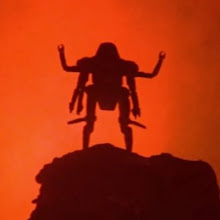
Above: Firecloud and Artra on The Last Generation #1 cover (1986).
These days, it must be difficult to be an independent comic book creator, even with the advantages bestowed upon them by technology, computers, and the Internets. Imagine, though, what a difficult feat the creation of a new comic book series must have been in the mid-1980s, when the use of personal computers was still in its infancy and the Information Superhighway was years in the future. Somehow, though, Memphis-based comic book creators Dave Bennett, writer Bill
Bryer,
inker David Porch, and artist
Mitch Foust found a way, and in so doing, they created
The Last Generation, an anthropomorphic, post-apocalyptic black and white comic book series which saw its first issue brought into being in 1986.
Published by Black Tie Studios, the series was certainly ambitious. With a mythology that spanned
millennia, beginning in the times of ancient Egypt and going forward thousands of years, well into the distant future, the series attempted to create a vast mythology addressing issues of bioethics, nuclear proliferation, and space travel. The principal narrative is set several hundred years in the future, and the protagonists are these:
Firecloud (a warrior Bear with shamanistic powers who is the last of his clan),
Artra (a wolf and a thief who carries a strange and powerful radioactive medallion emblazoned with a peace symbol),
Eremos Polastar (a mentally unbalanced humanoid with memories and dreams of the past which may or may not be real),
Sh'Kreech (a winged female archaeologist in love with Polastar), and Thomas
O'Malley (a former resident of the twentieth century awoken from his cryogenic sleep chamber by the other aforementioned protagonists). Ultimately, the five of them band together, in part driven by
Polastar's quest to find the mysterious "
ben-
ben," an artifact which dates back to Egyptian times and may, in fact, be extra-terrestrial in origin. Complicating all of this is the presence of a sinister villain, Dr.
Clavius, who in the 1990s tricked the world powers into nuclear disarmament by rendering all nuclear material in the world inert. The protagonists find themselves in the hollowed-out mountain lair of
Clavius, who is somehow still alive. Much of this the reader must piece together, as the back story is something that must be ascertained from bits and pieces of the narrative, as well as supplemental materials outside the narrative proper, like a time line which appears in several issues or copies of news articles about the characters.
In the very first issue, the introduction notes that the series would be limited to eighteen issues:
Unlike so many of today's story lines we want you to know that this one has a definite end. The way I now have it plotted the book will end on/or about issue 18. For those of you who like riddles the book has a beginning and an end which is also its beginning. We hope that you will our story through to its end.
In late 1986, Memphis's
Commercial Appeal newspaper ran a story on local comic book creators, including those behind
The Last Generation. In the piece, the author explored their diverse backgrounds and their connection to the characters they had created:
"There's a lot of people who know me as a police officer because I come in contact with 'em, said David Porch, who put pen and brush to The Last Generation. "Hopefully, a lot more people one day will know me as a comic book artist."
...
"The characters are not just supernatural beings who can leap over a building in a single bound," Porch said. "They all have well-developed personalities. We kind of see ourselves as the characters."
Porch, a member of the motorcycle squad of the Shelby County Sheriff's Department, sees himself as Artra, a prankish wolf who walks upright and wars a strange artifact - a peace medallion.
Mitch Foust, the comic's main artist and a shopping mall airbrush artist by profession, is big and bearded. He's reflected in Firecloud, a warrior bear.
Hobby-shop worker Dave Bennett helped conceptualize the comic and work out the business problems. His long blond hair is the visual basis for a restless seeker-after-truth named Eremos Polestar, who cavorts with a beautiful winged woman.
Only Bill Bryer, a factory parts worker, who scripted the book, doesn't have an alter ego in the story.1
(Note: These guys weren't the only ones in Memphis producing indie comic books back then. Memphis-based Philip Hwang achieved some level of success in the mid-1980s with his similarly independently produced
Hey Boss! #1, a Bruce Springsteen parody, which we here at
Chronological Snobbery profiled in
this piece back in 2007.).
 Above: from left to right, are Dave Bennett, Bill Bryer, David Porch, and Mitch Foust.
Contacted in late 2007, before this
blog's extended hiatus,
Foust, Porch, and
Bryer were kind enough to submit to brief email interviews. (Efforts in both 2007 and 2010 to locate Bennett were unsuccessful.). We've collected the three sets of creator interviews below.
1. How many issues of The Last Generation were published? I understand the original plan was to have 18 issues, published four times a year. Were you able to complete that plan? FOUST: We actually completed five issues. By issue three, we had a good friend, Rich Herold, to do the lettering. After issue 4 was complete, Rich was killed in a car accident. It really took a lot of the wind out of our sails. The main reason the books were never finished was that I couldn't meet the deadlines. We averaged about one book a year.
PORCH: Only five issues? It seems like it was a lot more than five books with all the blood, sweat, and tears we put into each issue. I was intrigued by the story that we wanted to tell and was personally saddened that we never got the opportunity to complete the series. The plan, as with so many things in life, did not go as intended.
The death of Our Book was TIME. We did not have enough of it. All of us, Bill, Mitch, Dave, and myself all worked full time jobs. I had gotten used to eating and decided a steady job was the best way to continue the habit. I had no illusions or expectations of the book making me wealthy beyond my wildest dreams, so from my point of view,
the book was a labor of love. As I alluded to earlier, time was the major factor for the book's demise. Time was required for writing, drawing, inking and toning the books. In the five years we worked on the books, we averaged one issue a year and you cannot do that and survive in the comic business. Naturally, with every issue after the first one, our sales were becoming less and less and finally, with the fifth issue, the decision to stop production was made. A labor of love is one thing and losing money to keep the series going, well, that's another thing altogether different. Mitch and I did all the artwork for the series. We both did full paintings for the front and back covers as well as doing other art projects like the prints that went into the portfolio. With full time jobs, there was just not enough personal TIME to finish the books.
BRYER: Yes, we had planned to publish eighteen issues, and I had the entire story line plotted out from beginning to end for those eighteen issues. We did only complete five issues and the portfolio, but we had a compilation printed which included a reprint of issues one through three along with an introduction by Chuck Dixon. The short of it all was our letterer, Rich Herold was killed in an automobile accident while going to Memphis State University (as it was called then), Mitch Foust lost his job at the T-shirt shop he was working at and he decided to open his own business, and we did have the time to invest in the project anymore along with the fallout of [comic book] distributors in the late eighties and early nineties. We had several of them go bankrupt, and we never received payment for our books that we published and shipped to them.
2. Have you collaborated with your Last Generation colleagues on any other projects?FOUST: I haven't seen or heard from Bennett in years. Bill and I keep in touch, His wife cuts my hair. Porch is a real close friend. We haven't worked on any other major projects together. A few illustrations, but nothing major.
PORCH: I am sorry to say that with the exception of Mitch, I have not worked on any other projects with the guys. For a while after the book, Mitch and I did work together on generic prints for fantasy and sci-fi conventions. As with the original arrangement, Mitch would pencil in the artwork, and I would ink the pieces. Over time, damn that 'word' again, we did less and less collaborating, and now, Mitch has developed into quite a good pinup artist with a neat web site, and I basically do commissioned artwork and haven't thought a lot about The Last Generation, but what thoughts I do have, are fond memories.
BRYER: No, we all sort of went our own way, and Bennett actually left after the third book or so, and we took on Rich Herold. When Rich was killed, we dedicated our fifth book to him, and I even rewrote the story to include him into it.
 Above: The Last Generation #2 cover (1987).
FOUST: The whole world was different. Diamond wasn't the only comic distributor. Capital was very good to us. We sold to four or five others, including Diamond. The demise of the other comic distributors certainly made our sales numbers dwindle. We did comic store appearances, regional conventions, and old fashion mail outs. We had some good heat at first, but with the glut of black and whites, it got harder to get attention.
PORCH: Self publishing is an easy concept to come up with; however, bringing it to life bears as many problems as Dr. Frankenstein faced in creating life in a dead body. Bottom line is that you have to have a good product, or no amount of marketing or promotion is going to bring it to life. The Last Generation was my first contact with the business end of the comic industry. Up to this time, I only bought and read comics. Starting out in the pre-Internet era, you have to have a product in hand to be able to send out to the distributor, the retailer and any other promotional outlet you can think of. A book in the hand was always worth more than a picture in a catalog to convince people to carry your product. Having a product in hand, means that you have already contacted several printers and gotten the best price per book for printing. You have set a production date and once the books are printed, you can store them somewhere until you can ship them out. You have handled the menial tasks of physically handling and packing orders. When you sit down and look at the cost per book required to produce it (keeping in mind that the more your have printed reduces the cost per book, but also means that you have to sell more to break even) and how much you can charge for it, you think, man - that's a good profit. Au contraire, self publisher. From the get go, everyone connected to the book gets a cut of the action. The printer gets his money up front - the distributor gets the book for a percentage of the cover price - the retailer gets the book from the distributor a little over what the distributor paid and finally, the reader gets the book at cover price. You had to anticipate how many books were to be printed for each issue, and if there was an over print, you lost money and if you under printed, you lost the sale. You had to have a major distributor like Diamond in order to get your book out nation wide. You just cannot make enough sales from your garage to survive. Today, with the Internet, it would be easy enough to get pre-orders for your product and print only what copies you need at the time. More individuals would be able to see a product with the click of a button. The money received would not have to be discounted through so many hands. With proper equipment, you could even print at home. Original artwork can be put on the Internet and bidded on. Before this, you basically had to handle the sale of the artwork at conventions or "again" through a distributor.
BRYER: It was very difficult as we came into the business right before the major fallout of the distributors and the collapse of the distribution network. As I said earlier, we had quite a few of them go bankrupt and not pay us for books that we shipped out to them. The marketing part wasn’t too difficult, and we even hooked up with several other small publishers that we meet at conventions and book signings and ran ads in our book for them and they did the same for us along with directly marketing to the distributors.
4. Of what part of the first issue are you the most proud?FOUST: Finally seeing a finished, printed book. It was the first time I had ever seen my work in print. Back then, there was no digital printing. If it was printed, it was offset. The first issue took us two years to produce. Just going through the process of getting the book printed was an education. The covers were manually color separated. THAT is a dying, if not dead, art in itself. To actually hold the book for the first time was great. The Last Generation was certainly a learning experience. We got to meet several people in the industry. Some became good friends. I would have like to have finished the project, but it wasn't economically possible at the time. Maybe one day. Probably not.
PORCH: Personally, even though the book was a great means of getting my artwork out to the general public, and I did enjoy doing the paintings, I would have to say I was most proud of the storyline. It had a lot of twists and sub-plots, as well as a surprise ending. I wish I could go into more depth about the story, but that wouldn't be fair to the guys or the fans. To be honest, at my age, I can't remember a lot of it. I noticed you did not ask about what part of the series I was least proud of. I'm going to tell you anyway. It was the countless hours spent with an X-Acto knife and form-X film laying down the tones and gradation that gave the book its look. The book may have been a Labor of Love, but I didn't LOVE that part of it.
In closing, I would like to add that I would not trade those years I spent with the guys (Bill, Mitch and Dave) for anything. It was a great learning experience and taught me a lot about myself. You don't know what you can do until you're under a deadline! To all our fans out there, I know of at least three, I am sorry that we did not get to finish the series. I don't like leaving anything undone or hanging.
BRYER: Well, the story starts off, in issue number one, page one with someone telling or retelling the story of The Last Generation in the last issue you find out who is actually telling the story and to whom. The actual story line would have been complete in a broad sense; however, there would have been plenty of room for continuation stories involving the characters who were left alive at the end of the first eighteen issues along with the new ones who would have been introduced at the end of this story.
For his part, Foust noted that he was only 20 or 21 when he began
The Last Generation, and the very first comic book page he ever drew was the first page of the first issue. At that time, he was spending 50 hours a week airbrushing t-shirts and attending college and notes that he initially "thought doing comic pages at night (after 10:00pm) would be easy . . . . Didn't happen that way." He's still in the game, though. You can see his current work at
his official website, which also features
an official biography which references his work on
The Last Generation.
By the second issue, the series was printing letters from its readers. Interestingly enough, one letter writer was
Landon Cary Dalton of Bowling Green, Kentucky, who would go on to win a 1998 short fiction contest and help create the
Batman: Date with Destiny fan film. His letter appeared in the second issue of the series, some of which I excerpt here:
Despite the fact that I was left with a handful of questions at the end of the first issue, I am still impressed. Why? Because the creators of The Last Generation have begun to tell a story that is so involving that I care about knowing the answers. I care enough to read the next seventeen issues.
Reached by email in late 2007, Dalton remembered
The Last Generation, copies of which he still has in his collection. "The comic book was recommended to me by the owner of a local comic shop called
Pac-Rats," Dalton recalled. "He was trying to support the book, and encouraged me to write a letter of support. The only other book he ever recommended in this way was
Roachmill." Interestingly enough, the second issue of the series is filled with letters from citizens of Bowling Green, because Tony Anello, and his daughter Kathy Anello, who owned Pac-Rats, offered a 100 percent money back guarantee for the first issue of the series on the condition that buyers was to send written comments to Tony, who forwarded them to Black Tie Studios.
 Above: The Last Generation #3 cover (1987).
In the fourth issue, Memphian
Charles Ettinger submitted a drawing of some of the characters for publication on its letter page and noted he wished to become a comic book artist (which came true). After Herold's death,
Ettinger would complete the lettering on the fifth and final issue. Reached in late 2007,
Ettinger was also kind enough to submit to a brief email interview.
1. What do you remember about The Last Generation comic book series?ETTINGER: That it was short lived. It had a lot of potential, but it's so hard to self publish. I remember the storyline and the art. It would have been nice to finish the story.
2. Do you remember submitting a drawing to that comic book for publication in its letters section? What prompted that?ETTINGER: Yeah, I still have the issue. I was friends with those guys, and they liked my art. I can't remember if i asked them or they asked me to do it. I also got to do the lettering in the last issue.
 Above: The Last Generation #4 cover (1988).
3. Would you say that The Last Generation influenced your art and work in any way? If so, how?ETTINGER: I was influenced at the time by the encouragement of my peers. We had a great circle of guys who loved to do the same thing, and I learned a lot by just hanging out with them. I wouldn't say that the book itself was an influence, but the people that produced it were.
4. What are you up to these days with respect to art and comics?ETTINGER: Art wise, I do a lot of freelance work. I get to do cartoony and comic bookish stuff for ads and t-shirt art. I've also gotten into sculpting recently, so I plan on doing some comic related work in 3-d. The most recent published piece was a pin-up of Captain Carrot and the Zoo Crew for Roy Thomas' Alter Ego magazine. It was a real kick when the creator of the book approved of your art. What I'll do from here is a mystery, but I hope to get back into comics heavily in the near future.
 Above: The Last Generation #5 cover, the final issue (1989).
As noted above, Herold, who was involved in the production of the series, was killed as a result of a car accident in February of 1989. As noted by Bryer above, the fifth and final issue of the series was dedicated to Herold, who also served as the basis of a new character. (In a flashback, O'Malley recalls the 1989 death of a close friend named "Rich," whose death profoundly affected him.). At the time, Herold's passing was noted by
The Comics Journal:
Rich C. Herold, a penciller and letterer for Caliber Press, Eternity, and Black Tie Studios, died February 23 in a traffic accident in Memphis, Tennessee. Herold was a 22-year-old graphics art student at Memphis State University.
Herold worked as the letterer on Black Tie Studio's The Last Generation #4 and had finished lettering the second half of issue 5 at the time of the accident. Herold was also lettering "The Philistine," a three part story scheduled for Eternity's Shattered Earth Chronicles.
The Last Generation penciller Mitch Foust called Herold "very energetic and real inspirational."
"His enthusiasm, his drive was so remarkable," Foust said. "He didn't mind redoing work as long as it turned out right. He had so much potential."
Herold was also penciling and lettering "Fugitive," a story written by Charles Marshall and inked by Greg Cravens that premiered in Caliber Presents #4. Caliber Presents #6 will feature a Fugitive cover from a design by Herold finished by Foust and Cravens.2
Cravens was also kind enough to submit to an interview in 2007 regarding his memories of both Herold and the Memphis comic book community in the 1980s.
1. How would you describe the independent comics scene in Memphis in the mid to late 1980s? How did you come to meet Rich Herold?CRAVENS: The independent comics scene in 1980's Memphis is probably the same as it is now - and the same as it is in every town all over America. There are a lot of enthusiastic beginners pouring their time and energy into their projects, and whatever shakes out is whatever shakes out. Rich and I hung around in the same 'comic book/cartooning crowd'. At the time, The Mall of Memphis was still the #1 retail space in Memphis, and we all circulated around the T-shirt shop that employed me, Mitch Foust, A.G. Howard and a few other cartooning enthusiasts. We went to Memphis State together. He was a little younger than me. I missed out on the new Apple computer lab that the graphic design department opened when I was a senior, so Rich set some type for me for my senior project.
 2. Do you remember The Last Generation series? What do you think is its legacy?
CRAVENS: Of course I remember The Last Generation. That was Mitch, Dave and David's big project. We all sort of floated in that atmosphere of "What are you guys doing with it now?" Its legacy? Hard to say. Rich's legacy to The Last Generation was that it went on longer than it would have if he hadn't breezed in and put more life into it. The way I remember it, Mitch and the Daves had decided to move onto other projects (Mitch and Dave Porch were already doing painted covers for other comic companies by then) and Rich convinced them, with his boundless energy, that they should let him do some of the grunt work, lettering and the like, and that they should keep it up. Similarly, Rich and I, and Charles Marshall, were doing stuff for Caliber Press. He breathed a lot of life into our 'Fugitive' series. Plus, Rich handed me some work that had been offered him - illustrations for a new newspaper, The Memphis Flyer. Rich never saw any of this stuff go to print. It was monstrous. He gave us all this energy and drive and got us all fired up and worked as hard as all of us, and never saw any of it hit the stands. I drew my first Memphis Flyer cartoon just after getting the news that he wouldn't ever see it.
3. What are your memories of Rich? How did you learn that he had passed away?CRAVENS: My memories are the same goofy memories you have of best college buds. He and I cut apart a crackerjack box to hide an engagement ring inside it for a girl he proposed to. We threw him a birthday party in my apartment, and when he nodded off late in the evening, we taped him to the couch with every inch of tape in the place, which was a considerable amount. We went to a Joe Kubert's School seminar at UT-Chattanooga. Drove all night to get there. Kubert saw us and said "Oh, the sleepless Memphis guys again..." I remember his sketchbooks. All pencil. All crazy overdone doodles with neat concepts behind them. He was manic, really. Once, in my kitchen, he was all cranky and pissed off (I think it was because the girl didn't want to marry him) and idly, as he talked about whatever, he lazily reached over and got a spoon out of the drawer, nonchalantly pulled over the sugar container, laid out a line and made as if to snort this sugar right up his nose. He did the whole thing with a straight face, then cracked up as I realized what he was doing. Classic comedic misdirection, too, with all my attention on the conversation. He and I decided that we'd start working out together in my apartment's gym after that. Typical- "Yeah! We'll get up early and work out and get all studly and everything!"
I learned of his death when Mitch called and told me. I had to finish my first Memphis Flyer piece, for their second issue- a gig that Rich got me - that night. It hurt, that he wasn't sitting in the apartment cutting up with me while I finished it. And, like I said, he never got to see those cartoons, nor Fugitive, nor The Last Generation that he worked on go to print. He was a roadsign for all of us, pointing us the way we should drive ourselves, and then he was gone.

Above is pictured a flier promoting a January 17, 1987 appearance by the creators of
The Last Generation at the now defunct Memphis Comics and Records' South Highland location. Note that at the event a "Watchmen trivia quiz" was conducted. (I wonder if those assembled at that 1987 event suspected they would have to wait another 22 years for
a Watchmen film adaptation, and that upon its release in 2009, it would be such a terrible comic book adaptation).
In the spring of 1992, the
T. Joseph Clifton Gallery at the Humphreys Center in Memphis featured work by Porch and Foust, including artwork from
The Last Generation.
3I myself acquired a copy of the first issue of
The Last Generation way back in 1987 and met the creators at an in-store signing on the same day. I'm not sure when I purchased the second issue, but it was not until 2007, when I began to research what would become this piece, that I located and bought the final three issues. With its premature cancellation following its fifth issue, the mysteries and foreshadowing in the series' five issues were left mostly unexplained. What was the ben-ben? Was Polastar from the distant past and/or from outer space? How did animals acquire human traits? Why was Artra's medallion significant? What was the endgame of Dr. Clavius? To where did Dave Bennett vanish? We'll never know. But considering the Herculean task of creating and self-publishing a series in the 1980s, a five issue original run is quite an accomplishment indeed.
Be certain to click on the comic book covers shown above for much larger images of the paintings done by
The Last Generation artists. For additional reading on the independent comic book scene in Memphis in the 1980s, see:
Footnotes1.
John Beifuss, "Hopes hang on superheroes: Comic Book creators view task as serious business,"
The Commercial Appeal (Memphis, TN), December 29, 1986.
2. "Caliber Presents Artist Rich Herold, 22, Dead,"
The Comics Journal, #129, p. 21 (May 1989) (internal links added).
3. "Best Bets,"
The Commercial Appeal (Memphis, TN), March 27, 1992.
 Twenty years ago today, on May 1, 1990, Billy Idol released Charmed Life, his fourth solo album. Most recall that album today for one reason and one reason alone: the video for "Cradle of Love," that album's first single. That video featured 18 year old Betsy Lynn George, dancing lasciviously in the apartment of a shy geek. Of course, then, no one knew her real name; she was to everyone simply "the girl from the 'Cradle of Love' video." George played Devon, a young neighbor of the geek in question, who knocks on his door and asks if she might possibly use his cassette player to listen to a song, "Cradle of Love." As the song plays in the geek's apartment, she dances ever more provocatively, and then kisses him. The song ends, and her boyfriend appears at the geek's door to locate her. She leaves, as if nothing happened.
 Born in June of 1971, George appears to have vanished into the pop culture ether since the 1990s. (According to IMDB, her last formal credit is from 1997, and most of her credits were not exactly A-list flicks. See, for example, the racy trailer for this 1996 softcore film, Petticoat Planet, about a world of women visited by a single male extra-terrestrial, in which George appears as the character, Lily). She did, however, appear in an episode of "Twin Peaks," as well as in "Melrose Place," "Baywatch," and "Lois and Clark: The New Adventures of Superman." Apparently, in 2000, and again in 2002, VH1 investigated her whereabouts in a series of specials entitled "Where Are They Now? Video Vixens" (videos for which I've been unable to locate online). It's unclear whether a new interview of George was done for that series. However, in one online summary of that broadcast, it is noted:
 In 2008, Katie Charles of New York Magazine, writing about an upcoming Billy Idol concert, referenced George and her role in popular culture:


 1. Katie Charles. "Agenda." New York. Vol 41, Issue 30 (August 25, 2008).